

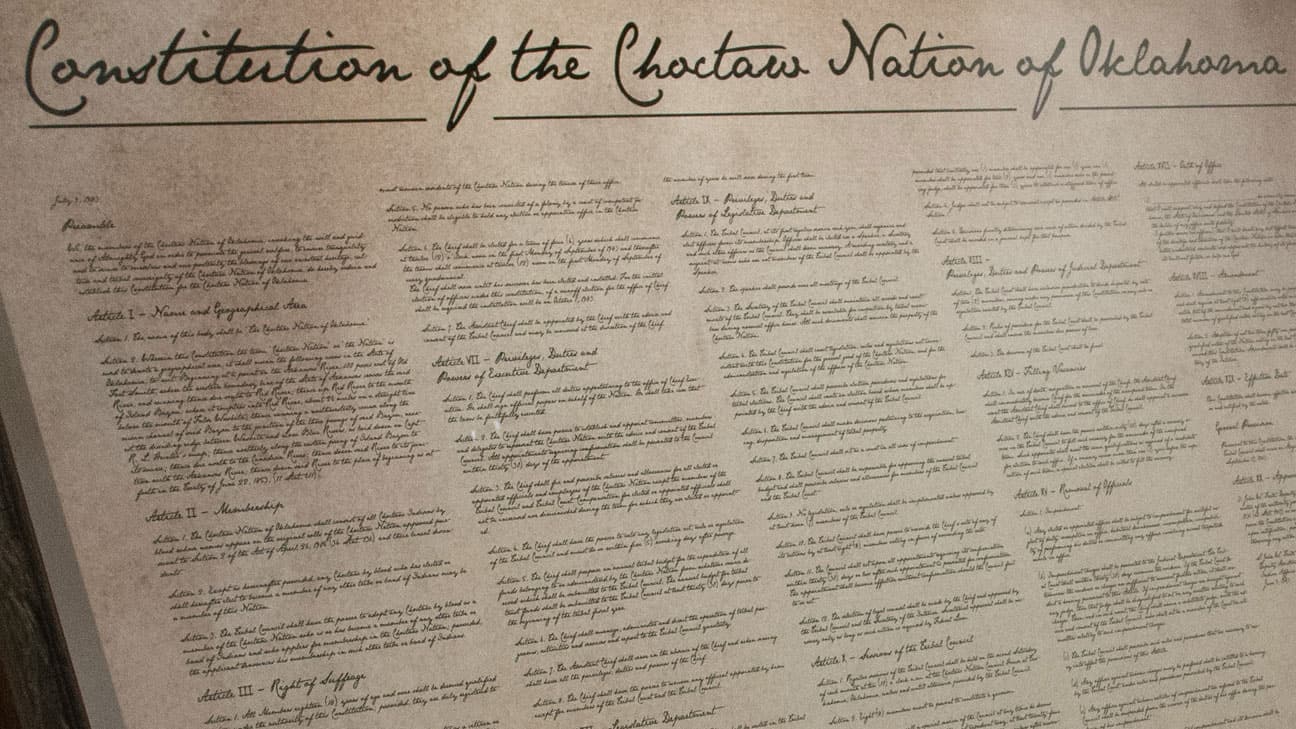
A copy of the Choctaw Nation Constitution is publicly displayed at the tribal headquarters in Durant, Oklahoma.
Two centuries of Choctaw constitutionalism
Iti FabvssaPublished August 1, 2026“The chiefs and warriors of the different districts of the Choctaw Nation, having met in general council for the purpose of taking into consideration the affairs of the nation.”
These words begin the preamble to the first written Constitution of the Choctaw Nation, ratified two centuries ago in Mississippi, on August 5, 1826. This month, Iti Fabvssa celebrates two centuries of Choctaw Constitutionalism and explores how the Choctaw Constitution of 1826, and its successors, can be remembered even today.
It is important to state that, although several historians claim that the 1826 Constitution marks the beginning of “organized government” in the Choctaw Nation, that’s far from the truth. For the Choctaw Nation, the authority to govern itself and oversee its own decisions has existed since time immemorial.
Prior to 1826, the Choctaw Nation’s power structures, decision making capacities, and governing processes were mostly held through traditional law customs. We can understand many aspects of historic government through surviving treaties, documents and historic accounts, but the 1826 Constitution serves as the first written Constitution of the Choctaw Nation and can be studied in its original form. Over the last two centuries, the Choctaw government has continually revised its constitutional doctrine based on the needs of the era.
The first written Choctaw Constitution was ratified on August 5, 1826, and largely reflected the Choctaw Nation’s priorities and responses to the world around it at that time. It was revised and ratified again as many Choctaws were crossing into the present-day Choctaw Nation in 1834. After Chickasaw citizens were adopted by the Treaty of 1837 in Doaksville, the Choctaw Constitution was revised again in 1838. Further revisions and amendments occurred in 1842, 1850, 1857, 1858, 1860, 1861, 1863, 1883, 1897, and 1902, with each generation of Choctaws addressing key issues that impacted their lives.
It is important to remind readers that statehood did not stop the Choctaw Government, although it changed the way that Choctaw Constitutionalism was observed.
After Oklahoma statehood, some Choctaws fought to reignite historic constitutionalism in the 1920s, and again in the 1970s, while other leaders pushed forward in new and complex ways. In the present day, the Choctaw Nation of Oklahoma recognizes the 1983 Constitution as its most recent constitutional doctrine, and even that is directly influenced and impacted by all of its predecessors.
Each document from 1826-1983 has directly influenced its successor, with passages, phrases and concepts which have endured since the very beginning of written Choctaw Constitutionalism in 1826. The September 2021 Issue of Biskinik contains a complete transcript of the 1826 Choctaw Constitution. It also includes a very helpful overview of the document and what it did for Choctaw governance of the era. While this particular issue will discuss the document briefly, we recommend readers visit that article as well.
At its core, the 1826 Constitution is comprised of only seven articles, each addressing an aspect of Choctaw governance during the era. While some articles introduce entirely new ideas, others attempt to standardize or even preserve historic government customs.
Article 1 outlines the General Council of the Choctaw Nation, which was designated to meet at least twice a year. Historically, Choctaw leadership from each district would gather to make decisions as a nation, but there had been no regularly scheduled sessions. This change was important to unify decision making and create a standardized frequency of in-person meetings for all representatives of the Choctaw Nation. Although today the governing body may look different, and the National Capitol has relocated from Mississippi, Choctaw leaders from across the reservation area meet at the present national capitol, Tvshkahomma, each month for regular scheduled meetings.
Another key aspect of Article 1 is the ending line, which states, “Any law or custom of a particular district, which conflicts with a general law shall be void.”
Although customs and laws could still be observed and created at a local level, this provided the framework for a national legal system, which was unique at the time for the Choctaw Nation. Today, the Choctaw Nation still observes this national standard for lawmaking and exercises it through the tribal legislature and judicial system.
Article 2 addresses land sovereignty and provides that “No district shall ever sell, or part with, any portion of this land without the full and fair consent of the other two districts.”
At the time, it was a common tactic to leverage debts or sales on land and force the Choctaw Nation as a whole to be accountable. This article helped prevent colonial powers from making treaties or predatory business deals with officials or citizens from only one district, which would negatively impact the Choctaw Nation as a whole. This was the written continuation of the Choctaw Nation’s land being held in common property, a system so robust that aspects of it survive even today.
Articles 3 through 6 work to establish early aspects of legislative and oversight committees, law enforcement, and also vital checks and balances in Choctaw Nation’s finances. Article 4 allows for a certain number of men to prevent disorderly and improper conduct at the councils and distribution of annuities. Today, at council sessions, there are still officers designated for this exact purpose.
Article 7 provides for the creation of a National Council House, which was established near what is now the city of Starkville on the Noxubbee River near the Noxubbee County line. Although the National Capitol has moved several times since 1826, Choctaw Nation’s present capital city, Tvshkahomma, was first ratified by Choctaw voters in August of 1883 and still serves as the Capitol today, thanks to the 1983 Constitution’s continued observation of this historic meeting place.
When we celebrate the Choctaw Constitutionalism or the 1826 Choctaw Constitution, we don’t celebrate the beginning of the Choctaw Nation, nor do we celebrate the beginning of tribal sovereignty, as those things have always existed. Celebrating the Constitution of 1826 honors an important milestone in the history of the Choctaw Nation, one that still has a meaningful impact today.
For more information on the Choctaw Constitution of 1826, check out the Sept. 2021 Iti Fabvssa article that includes a full transcription of the document.