
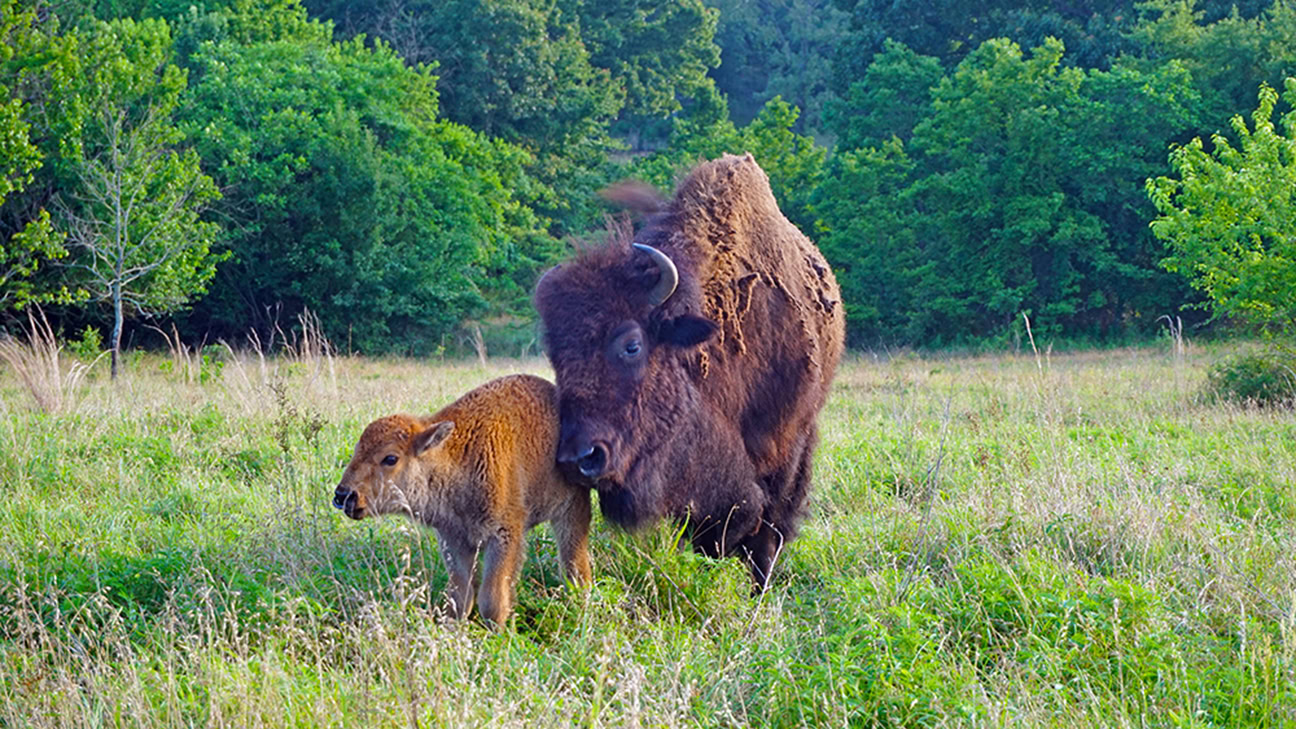
Pictured are a bison cow and calf, Nan Awaya Farm, Atoka County.
The Buffalo are coming to the Choctaw Cultural Center
Iti FabvssaPublished January 1, 2026A rare gem of Choctaw culture and land is located right next to the Choctaw Cultural Center in Calera, Oklahoma. It’s 100 acres of native tallgrass prairie. This prairie has been here on this same piece of ground for thousands of years. When Choctaw people arrived on the Trail of Tears, they encountered prairie landscapes across the western and southern portions of the reservation – areas around present-day Valiant, Durant, Atoka, and McAlester. In the intervening years, almost all of the tallgrass prairie has been destroyed on the reservation and across the American heartland. Representing what was once common in our area, the section of tallgrass prairie at the Cultural Center is now one of the highest quality still-surviving remnants anywhere on the Southern Plains.
Driving into the Cultural Center, some visitors may look at the prairie beside the road and see it as just open space, but really, this is our region’s rainforest. In 2025, the Oklahoma Biological Survey documented more than 200 native plant species growing in this remnant prairie. Many of them are rare. Many of them have names in the Choctaw language and uses in Choctaw culture. This remnant is also home to rare native insects and to grassland birds that are disappearing across the American heartland. Yet, the biggest part of any prairie is what you don’t see, the part that lives underground. With their roots extending down as much as 15 feet, the prairie plants essentially farm tiny microorganisms in the soil, which provide essential ecological functions, like trapping nitrogen, protecting plants from disease, and holding onto soil moisture. There are millions of species of tiny life forms living in the prairie soil. Most have not yet been named by science, but they might very well be able to one day teach us how to make powerful new medicines, how to farm to feed the world’s growing population, and how to make our communities and land more resilient.
In September, Iti Fabvssa talked about the important place that prairie has in Choctaw culture and history. As Indigenous people, our relationship with the land is timeless. In other words, our cultural connection with the land is not just something from the past; it’s also something that is relevant today. In our area, prairie remnants exist only through a continuing relationship between people and the land. The tallgrass prairie is alive in every sense, constantly changing. The appearance of the Cultural Center shifts from week to week, influenced by temperature, rainfall, and many other factors. If left on its own, a prairie like this one will grow up into a cedar grove or a thorny thicket in a few years. It needs regular disturbance to continue to be a prairie. Historically, this disturbance came from two main sources: range fire (a future Iti Fabvssa topic) and grazing animals. For the Cultural Center prairie to be at its best, we need to provide those.
Bison, “yvnnvsh” in the Choctaw Language, are natural prairie managers with deep ties to Choctaw culture, both in the homeland and here in Oklahoma. Their favorite food is native grass.
A bison has front teeth only on its lower jaw; its upper jaw lacks incisors. This helps to prevent it from damaging the grass by grazing it too low. When a grass plant gets grazed, the plant pulls resources from its deep roots and sends up new growth above ground.
The new growth is highly nutritious to bison, who eagerly graze it. For a few weeks or months, the grazing/regrowth process repeats, but eventually the grass roots start to weaken, and the plant quits sending up vigorous growth. With the grass stunted from repeated grazing by the bison, diverse wildflowers start to take over the landscape. They provide food and habitat to hundreds of species of native bees and butterflies (species which, like the birds, are disappearing across the American heartland).
Most wildflowers are not tasty to the bison. In the past, when a landscape became dominated by them, the bison would move on in search of fresh grass elsewhere. The wildflowers would dominate for a year. As the grass rested, its roots would regain the resources needed to send up new shoots. In the absence of grazing, the grass begins to build up thatch (dry dead matter from the previous season’s growth). The thatch would carry a range fire, set by Native people or a lightning strike, right across the landscape. The fire would blacken the ground with nutrients and clear space for the grass to grow.
Immediately, the grass would send up new, fresh shoots. The bison would be attracted to the tasty treats, graze the fresh grass, and start the cycle over again. This cycle of burning and grazing is what maintained the prairies in southeastern Oklahoma and in the Choctaw homeland. In the absence of grazing, prairie is less diverse and provides a less ideal home for native birds and other creatures.
In the near future, Cultural Services will be bringing a small herd of bison out to live on the Choctaw Cultural Center prairie to help us maintain it. If you drive by, you’ll see the Choctaw Nation Cemetery Crews building fences for them. The bison will be partners in helping us to be good stewards of this irreplaceable native landscape. We’ll manage them through a technique called patch burn grazing, where the land will be exposed both to bison grazing and controlled burns, mimicking the same conditions that shaped and maintained this same prairie as a dynamic ecosystem over thousands of years.
Cultural Services has begun offering hands-on programming to groups on the prairie remnant. These will be expanding in the future, and soon, will include getting to visit and learn about the bison. We’re not set up to accommodate programming for individuals, yet, but if you have a school group, church group, or community group and would like to schedule an educational visit to the Cultural Center’s prairie, please reach out to the Choctaw Nation Historic Preservation Department at [email protected].