
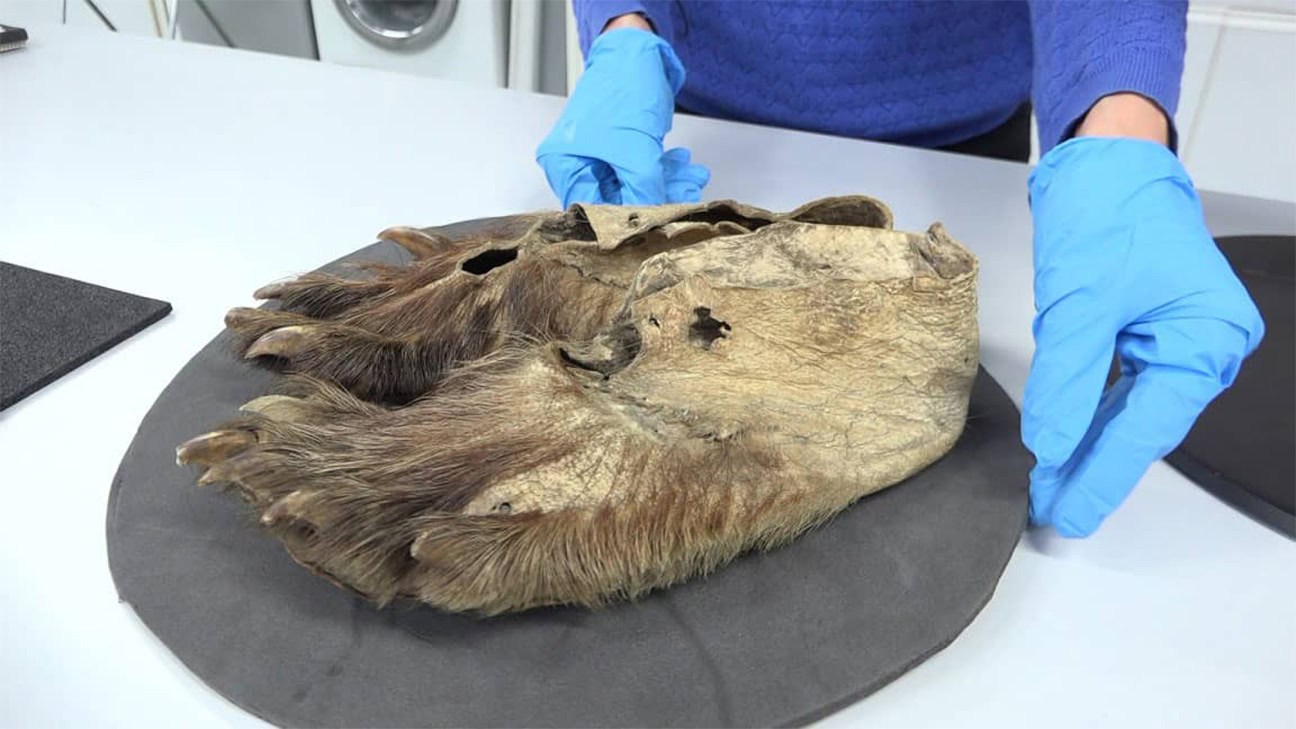
A curator prepares a pair of bear paw moccasins from North America for the exhibit “La Curiosité d’un Prince” opening this month in the Versailles Public Library in Versailles, France.
Renewing Choctaw-French Relations Through an Exhibit Collaboration
Iti FabvssaPublished October 1, 2021This month, we are continuing a short break from the “A New Chahta Homeland” series to share about an exciting exhibit that the Historic Preservation Department has been working on for several years.
On September 18, 2021, the Versailles Public Library in France opened an exhibit titled “An Inquisitive Prince: The Fate of the Ethnographic Cabinet of the Count of Artois,” the result of several years of collaboration between the Choctaw Nation of Oklahoma and two French institutions. The exhibit tells the history of a notable French royal collection of items collected from across the world in “curiosity cabinets.” Featured in the last room of the exhibit is a room curated by Choctaw Nation staff to show how the collection’s one-of-a-kind items have been part of our journey in learning more about the arts and lives of our Choctaw ancestors. The exhibit is also one component of a larger project that includes a blog and ongoing knowledge exchange about the items and their conservation. This project has involved the Musée du quai Branly-Jacques Chirac, the Versailles Public Library, Choctaw Nation Historic Preservation and the Choctaw Cultural Center.
In 2016, Choctaw Nation Historic Preservation Research Associate Jennifer Byram reached out to the Musée du quai Branly-Jacques Chirac to inquire about possible Choctaw items in their museum collections. This outreach was part of creating the Chahta Imponna Database, a virtual collection of items of Choctaw traditional art, housed in Choctaw Nation museums, the Choctaw Cultural Center, and other institutions around the world.
This contact-initiated a working relationship between Paz Núñez-Regueiro, who had just taken the position of Head Curator of the Americas of the Musée du quai Branly, and Jennifer Byram that led to an exchange of information and a virtual consultation in February 2018 regarding a number of the museum’s exceptional items from the 1700’s. During that time, Núñez-Regueiro noted the potential for a collaborative exhibit with the Choctaw Nation. Those early conversations created a dialogue that paved the way for this collaboration that harkens to the historic diplomatic relationship between Choctaws and the French.
When Spanish conquistador Hernando de Soto first met Choctaw warriors in 1540, Choctaws proved to be a powerful player in world politics. Following an initial meeting in 1700, Choctaws established a relationship with the French that grew over time. Throughout this era, French explorers brought back items from the Southeast and other parts of North America to elite French collections.
While France was a respected ally to a greater degree than their imperial counterparts, the taking of Indigenous nations’ items from their homelands and their placement into European royal collections and museums epitomizes the complicated relationship between Choctaws and France. Acquiring knowledge about Indigenous communities was integral to European empire-making and Choctaws were no exception. This era of rapid imperial expansion also contributed to the development of salvage anthropology which sought to document Indigenous communities before the Euro-American civilizational project assimilated Indigenous peoples and their cultures.
Across the globe, European empires collected items and featured them in museums and universities. Indigenous community members and scholars have long critiqued the colonial origins of many collections and advocated for institutions to collaborate with Indigenous communities (and repatriate items in some cases). U.S. laws like the 1990 Native American Graves Protection and Repatriation Act have also raised awareness about items in domestic collections and compelled such collaboration. Today, Choctaws are working to reconnect with the Choctaw items living outside of our community to reclaim and revitalize our ancestral knowledge and traditions, connecting us to Choctaw ancestors as far back as 500 generations.
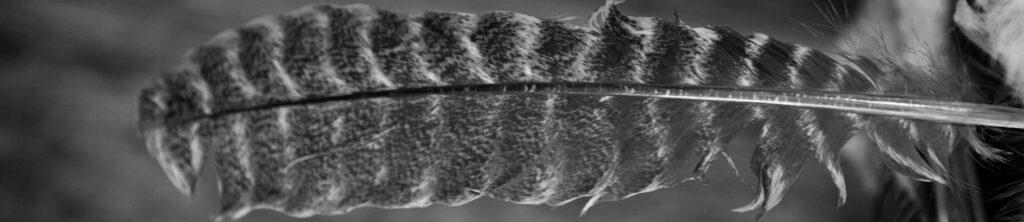
The Choctaw exhibit room features ten North American items from the French collection which were kept at the Versailles Municipal Library following the French Revolution in 1789. The items in the Choctaw room include a pair of bear paw moccasins, a man’s beaded trade cloth legging, a shell gorget and shell bead bracelet, trade bead jewelry, a quiver made of a gar fish hide, darts made of rivercane, and a quillwork and feather headdress. While the provenance of these items is unknown, they have clear associations with the Southeast and fit descriptions of items that Choctaws had during that time period. For instance, the headdress visually matches one worn by a Choctaw chief in a 1732 French painting by Alexandre de Batz and the bearpaw moccasins match a description of Choctaw war parties written by English trader James Adair.
Throughout the collaboration, both the Choctaw and French teams have been able to learn more about these items and gained insights into how they were made. One major objective of our exhibit room was to remind the international audience (who might not know about Choctaws or Native Americans) that we are a thriving, contemporary nation. To accomplish this, Historic Preservation created a new map that shows the geographical journey of Choctaw people on the land since the beginning of time. Alongside each of the exhibit items, we featured photographs of several Choctaw artists and their works alongside the collection items. The artists featured in the exhibit include Ruby Boulding, Colina Hickman, Brad Joe, Michael Rose, Eveline Steele, Les Williston, and the Choctaw Traditional Textile group.
Integrated throughout exhibit are images of Choctaw social dancers, the Choctaw homeland, and a group of Choctaw youth visiting the Choctaw village site of Bottle Creek during the 2018 Indigenous Immersion Camp. Lastly, we showcase a short film by Mark Williams that shares how Choctaw Nation staff and community members worked with and learned from the French collection as part of our ongoing cultural revitalization work.
This exhibit video includes information on the history of Choctaw and French relations, and reflections on the collection’s significance to our Choctaw community. For project partners, the most significant moment of the exhibit was listening to Choctaw elders’ insights on the production of them items and watching their first reactions to seeing these pieces that hold vast amounts of Choctaw knowledge. We plan to release more videos reflecting on different aspects of the collaboration on the project blog. We aspire to one day bring these items to Oklahoma for more of these encounters across time and space, facilitated by the works of these ancestors.
This project is just one of many that the Choctaw Nation has embarked upon to share the knowledge of our ancestors with the Choctaw community and beyond. As we mentioned at the beginning of this article, this collaboration developed out of the work of creating the Chahta Imponna Database. This database is also part of Hina Hanta, an online database that shows the items held at the Choctaw Nation Capitol Museum, Wheelock Academy Historic Site and the Choctaw Cultural Center. Staff from these institutions have worked hard to bring attention to these items and make them accessible to our community members, no matter where they live. Lastly, these projects have helped us to create lasting working relationships with institutions across the world to rectify and reconcile harms of the past.
This exhibit collaboration between the Choctaw Nation of Oklahoma and Musée du quai Branly is a testament to the historic relationship between Choctaws and France as well as the complex relationships between colonialism, museums and contemporary communities. The Indigenous items in the Musée du quai Branly collection have had long, storied lives and served many purposes during their journey from the former “Louisiana” region of the 1700’s to the present. These items embody the relationships between diverse peoples from the eighteenth century and the journeys made across thousands of miles and hundreds of years. They also serve as a bridge for us to better understand those who shared the same world and time as these items and the relationships with the distant nations that took the items to Paris.
By reconnecting with Choctaw items, we are also reconnecting with our ancestors who made and used them. Not only have these items helped us reinvoke our nation-to-nation relationship 250 years later but they also illustrate how Choctaws have an enduring sovereignty that we have continually asserted throughout history. These items crucially remind us that Choctaw politics are inherently international and are not solely defined by our relationship with the United States.
Over the course of this collaboration, Choctaw Nation staff have had the opportunity to reflect on the complex history that this royal collection raised. We have found that working together with these French institutions has helped us to establish a new chapter in our history with France, a crucial ally throughout the 1700’s. By collaborating with the Musée du quai Branly on this exhibit, we revisit these histories and its legacies, recreate new relations, and reconnect the items of our ancestors with our community. In doing so, these objects from the past will gain a new life in the present by helping us facilitate these relationships within our community and, through the legacies of our ancestors, with French partners. Additionally, we also highlight ongoing Historic Preservation work within the Choctaw Nation today, as well as the newly opened Choctaw Nation Cultural Center.
This collaboration will help us to show to you, our community, that the materials and relationships involved in this exhibit come out of Choctaw histories, traditions, and artistry and how they have brought us to who we are as Choctaw Nation today. Reflecting on the project, Paz Núñez-Regueiro, Head Curator of the Americas Collections at the Musée du quai Branly-Jacques Chirac, writes, “Throughout the exhibit, this collaboration was a wonderful experience and very enriching, a rediscovery of the objects and the role that collections and museums can have. In spite of the remote working conditions imposed by COVID-19, we were able to find a more effective way of collaborating by remaining in dialogue at a distance which gave me the tools to develop future collaborations based on this model.
This has without a doubt been one of the most beautiful collaborations of my professional life and I feel that I still have much more to learn from the Choctaw Cultural Center team. It is a very moving feeling to weave the relationship together again following the historic relationship that united Choctaw and French peoples in the 17th and 18th centuries.” On behalf of the Choctaw Nation of Oklahoma, we are honored to be a part of “An Inquisitive Prince,” a joint project involving the Historic Preservation Department and Choctaw Cultural Center. The Choctaw Nation co-curators of the exhibit are Jennifer Byram (Historic Preservation) and Cady Shaw (Cultural Center).
Other members of the Choctaw Nation exhibit team include Sue Folsom (Cultural Services), Stacey Halfmoon (Cultural Center), Dr. Ian Thompson (Historic Preservation), Misty Madbull (Historic Preservation), Megan Baker (Historic Preservation), and Ryan Spring (Historic Preservation). Co-curators in France from the Musée du quai Branly-Jacques Chirac are Paz Núñez-Regueiro, Head Curator of the Americas, and Nikolaus Stolle, Visiting Scholar; and from the Versailles Public Library, Vincent Haegele, Director, and Hortense Longequeue, Curator. You can learn more about the project, a part of the CROYAN (French Royal Collections from North America) initiative at Croyan Quaibranly.
On October 1, 2021 the Choctaw and French project teams of the exhibit will host a virtual opening that discusses the work that went into making it a reality. This will be available for viewing at the Choctaw Cultural Center.