
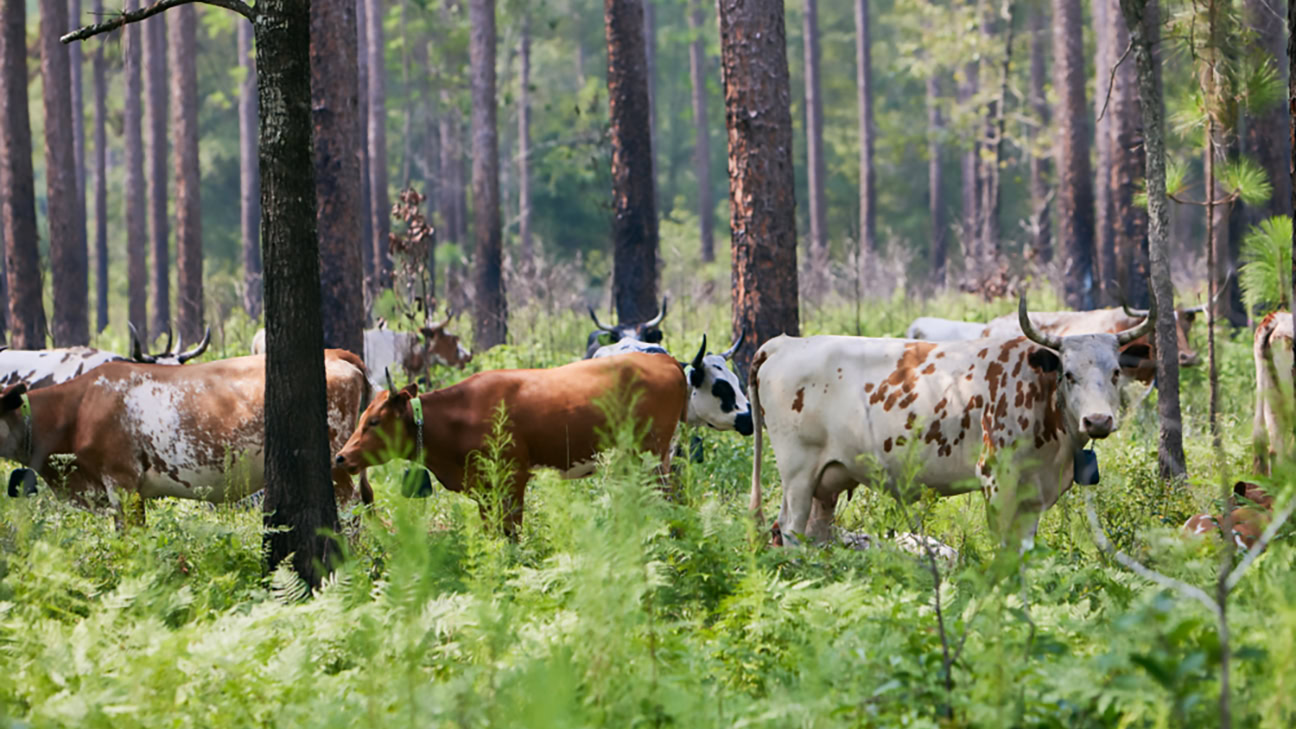
Pineywoods cattle on the Brosnan Forest, South Carolina
Pineywoods Cattle
Iti FabvssaPublished May 1, 2026By Choctaw Nation Historic Preservation Staff
This month, Iti Fabvssa would like to share a brief history of the Pineywoods Cattle breed, a breed of cattle used by Choctaw people for over 200 years. Starting in the 16th century, Spanish explorers and soldiers brought cattle into North America (Thompson 2026:68). Serving as both food and as draft animals, these cattle were used by Spanish, French, and English settlers in what is now the Southeastern United States. Through interactions with Europeans, Choctaw people adapted the word “wak” from the Spanish word for cow, “vaca” (Byington 1915:361). By the 1730s, a few Choctaw families had adapted to ranching and had herds of cattle within the Choctaw Nation. Over time, the cattle would be shaped by their environment and agricultural use into a new breed, called the Pineywoods Cattle (ALBC).
Pineywoods Cattle are a very hearty breed that has adapted to the environment of a region along the Gulf Coast known as the Piney Woods or Pine Belt, Tiak Faya in the Choctaw language. This region was managed by range fires that promoted one of the most diverse regions outside of the tropics (Thompson 2026: 111). Large pine trees and tall grasses dominated the landscape as hardwood trees grew in the fertile bottomlands along the waterways. The Pineywoods Cattle lived in this region and became perfectly adapted to it. The Pineywoods Cattle are heat resistant, long-lived, have resistance to parasites and disease, and can be productive on marginal forage (ALBC).
By the 1770s, ranching had become more common within the Choctaw Nation (Thompson 2016:68). Pineywoods Cattle are on the smaller side, with cows weighing 600 to 800 pounds and bulls weighing 800 to 1200 pounds. They are rugged and can be used for beef, dairy, and as draft animals (ALBC). They come in every solid color and most spotted patterns, with their horns ranging from long and twisted to short and crumpled (ALBC).
As time passed, increasing numbers of Choctaw families began to raise cattle for livestock. By the 1820s, there were over 43,000 heads of cattle within the Nation (Carson 1995:506). As the United States prepared to move the Choctaw Nation west to Indian Territory, they stated in the 1830 Treaty of Dancing Rabbit Creek that any cattle left behind in the homelands would be replaced upon the completion of the removal; this promise was not fulfilled. Some Choctaw families drove their cattle on the Trail of Tears and Death, but many cattle died due to the freezing temperatures and extreme conditions during the removal. Many were likely butchered along the journey to help feed starving Choctaw families.
Despite the thousands of cattle that were either left behind or lost due to removal, Choctaw ranching continued to increase once in Indian Territory. The tallgrass prairies in our new home, particularly along the Red River and the western boundary of today’s Choctaw Nation Reservation, were the perfect environment to continue the Choctaw cattle economy. In 1846, the Choctaw Nation passed laws on stray cattle and droving cattle. During the American Civil War in the early 1860s, Indian Territory was one of the largest producers of beef for the Confederate States of America; over 300,000 head of cattle were stolen from Indian Territory and resold, mainly in Texas. (CNHPD 2011). Principal Chief Wilson N. Jones, after the Civil War in 1866 or 1867, operated a mercantile business in Blue County, Choctaw Nation. He began ranching and took on a business partner named Myers. After they raised about a thousand heads of cattle, Myers took them to a livestock sale and stole the money. Chief Jones lost several thousand dollars, around $120,000 today (Crims 2025).
Choctaws would continue to use the Pineywoods Cattle in Indian Territory until the 20th century, when other breeds of cattle were promoted by the US for both beef and dairy production. Mechanized agriculture also reduced the need for draft cattle on farms. Today, the Pineywoods Cattle are considered a threatened breed that has survived in isolated herds maintained by a few American families in Alabama, Georgia, and Mississippi.
Some organizations are using the Pineywoods Cattle to aid in regenerative farming practices, and others are using them for wildfire prevention.
To learn more, visit the American Livestock Conservancy website.
Works Cited
- American Livestock Breeds Conservancy
- 2013 Pineywoods Cattle. Electronic document, accessed April 12th, 2026.
- Byington, Cyrus – 1915 – A Dictionary of the Choctaw Language. Bureau of American Ethnology, Vol 46, Washington DC.
- Carson, James – 995 – Horses and the Economy and Culture of the Choctaw Indians. Ethnohistory 42: 495-513.
- Crims, Reno – 2025 – Choctaw Chief Series: Principal Chief Wilson N. Jones. Tvshkahomma Capitol Museum Facebook Page. Article posted July 9th, 2025.
- Choctaw Nation Historic Preservation Department – 2011 – Choctaw Nation and the American Civil War.
- Choctaw Nation and the American Civil War Biskinik, October 2011, accessed April 12, 2026
- Thompson, Ian – 2026 – Choctaw Foods: Remembering the Land, Rekindling Ancient Knowledge. 2nd ed. Choctaw Nation of Oklahoma. Durant, OK