
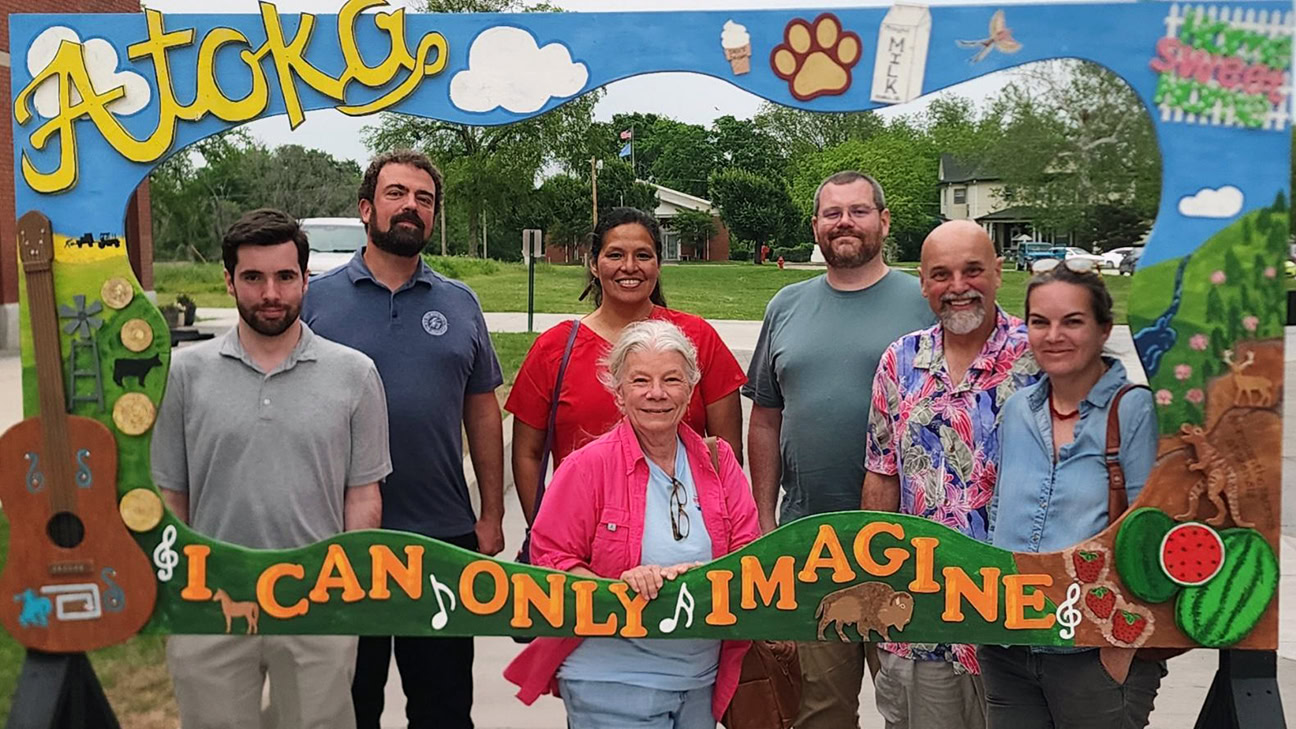
Some members of the Choctaw Collaborative Team during a visit from our partners in Alabama to the Choctaw Nation: Liam Hodges, Dr. Ian Thompson, Amy Thompson, Karen Downen, Dr. Ryan Morini, Dr. Philip Carr, and Sarah Price.
Indigenous Alabama: Digital Resources for Research
Iti FabvssaPublished December 1, 2025People usually think of the Choctaw homeland as being Mississippi. That’s not wrong, but many chapters of Choctaw history were written a little farther to the east, in what is now Alabama. This month, the writers of Iti Fabvssa would like to introduce a new online resource called Indigenous Alabama, which helps to share this part of Choctaw history from the perspective of the Choctaw Nation of Oklahoma.
Through partnership with the University of South Alabama, Alabama Department of Transportation, and the Choctaw Nation of Oklahoma Historic Preservation Department, this website hosts annoted sources about Choctaw history, culture, and heritage in western Alabama. These come from archaeology, anthropology, and historic maps.
At the time of European arrival, and for centuries before, corn was the single-most important food for the Choctaw ancestors. Two main Choctaw oral traditions describe how our ancestors first obtained it. According to one of tradition, corn was a gift from Ohoyo-osh Chishba “Unknown Woman”, the daughter of the Sun, given to two Choctaw hunters, who had shown her kindness. According to this tradition, she gave this gift on an earth mound village located on the Alabama River (Cushman 1899:276-278).
The Alabama River exists entirely within the present-day state of Alabama, ending near Mobile Bay and beginning near the center part of the state. A much older Choctaw oral tradition talks about the ecological impacts of the mammoth on the Black Belt Prairie, a landscape feature that extended from present-day northern Mississippi through central Alabama (Cushman 1899:207). Those animals went extinct 13,000 years ago.
Centuries later Choctaw-speaking villages would be located on the portion of the Black Belt Prairie in western Alabama. This is probably where Chief Tvshkalusa fought Hernando de Soto’s army in 1540. In other words, western Alabama was a home for some ancestral Choctaw communities for hundreds of generations.
For years, the Choctaw Nation Historic Preservation Department has kept track of ancient Choctaw place names on the landscape. There are hundreds in Mississippi, but there are also many in present-day Alabama, basically from the Alabama River westward. More specifically, Choctaw place names cover an area of Alabama that extends from the central Tombigbee and lower Black Warrior Rivers on the north, southward to the coast, and as far east as the mouth of the Cahaba River.
It’s important to not let the part of Choctaw heritage that lies in this area be forgotten. The purpose of the Indigenous Alabama website is to share and summarize sources that shed more light on this heritage. Choctaw history in Alabama is often overlooked by archaeologists and others doing Cultural Resources Management in the state, because so much focus is placed on Choctaw history in Mississippi.
Indigenous Alabama was created initially as a resource for people doing cultural resources management work, so that they can have access to published information about Choctaw heritage in the State of Alabama.
It is important for them to be aware of the Choctaw connection with this area so that they can help Choctaw Nation and other interested Choctaw Tribes to protect the Choctaw sacred and historic sites located there, share accurate information with public about the historic Choctaw presence in the area, and to do research that can shed even more light on Choctaw history, culture, and heritage in western Alabama. The website and the information that it contains are also intended for any Tribal members who might be interested in accessing it and learning from it.
So, what does the website actually contain? It’s broken up into different sections that focus on presenting Information from archaeology, anthropology, historic maps, and other sources that sheds light on Choctaw heritage in western Alabama.
The archaeology, anthropology, and other sections of the website present summaries of many dozens of published articles, and links to as many of them as possible. For each published source, the web site provides annotations that summarize the contexts of the article and talk about how this information relates to Choctaw history and culture.
The maps section includes images of dozens of historic maps tied to summaries that explain what they show. Many of these maps have information on where Choctaw people lived at specific times in the past, the environment and natural resources, and how our settlements were laid out.
It’s amazing to look at one of these maps and see the interconnected agricultural fields that interlaced between Choctaw villages or see the individual family hamlets of a Choctaw village, where female Choctaw family heads looked after their families. By utilizing these multiple sources of evidence, viewers can learn about the past lives of our Choctaw ancestors which still continue through today’s Choctaw culture.
All in all, Indigenous Alabama is a tremendous new source for information about Choctaw history and culture in the east. We’d like to thank the Alabama Department of Transportation for funding this work, the University of South Alabama for taking on the physical creation of the website, and especially Sarah Price and Dr. Phillip Carr for long hours of work entering and summarizing the data and working with the Choctaw Nation Historic Preservation Department. Yakoke! Indigenous Alabama is a good example of what collaboration can accomplish and will be a resource that people can use for years to come.
Works Cited
- Cushman, Horatio 1899 History of the Choctaw, Chickasaw, and Natchez Indians. Headlight Printing House, Greenville, TX.
- Halbert, Henry S. 1899 Choctaw Indian Names in Alabama and Mississippi. Transactions of the Alabama Historical Society. 3:64-77.
- Thompson, Ian 2019 Choctaw Food: Remembering the Land, Rekindling Ancient Knowledge. Choctaw Nation of Oklahoma, Durant, OK.