
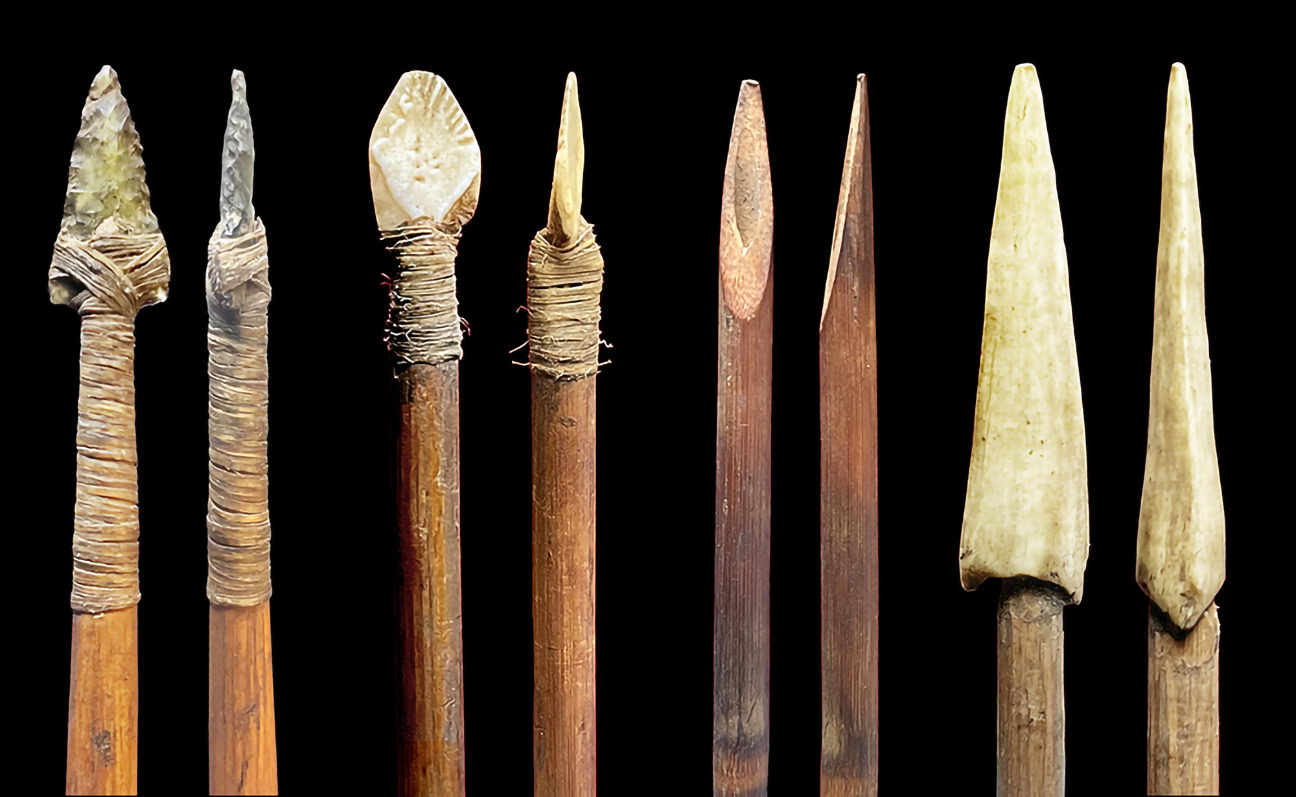
The tips of four arrows in the Musée du quai Branly collection are shown in flat and side views. From left: chipped glass, garfish scale, sharpened river cane and carved deer antler.
Ancestral Arrows: Continuing collaborations with the Musée du quai Branly–Jacques Chirac
Iti FabvssaPublished April 1, 2026By Choctaw Nation Historic Preservation Staff
In this edition, Iti Fabvssa continues sharing information from the one-of-a-kind Native American cultural objects in the collection of the Musée du quai Branly–Jacques Chirac in Paris, France. As a quick recap, the CNO Historic Preservation Department has been partnering with the Branly and with other Tribes to document, study, and connect this collection with culturally affiliated Tribal communities since 2017. Last year, some of the items in this collection that have a fair likelihood of being Choctaw in origin were displayed at the Choctaw Nation Cultural Center in Calera. Thousands of people came to see them.
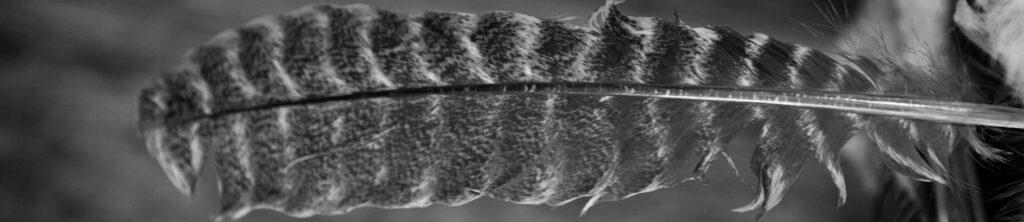
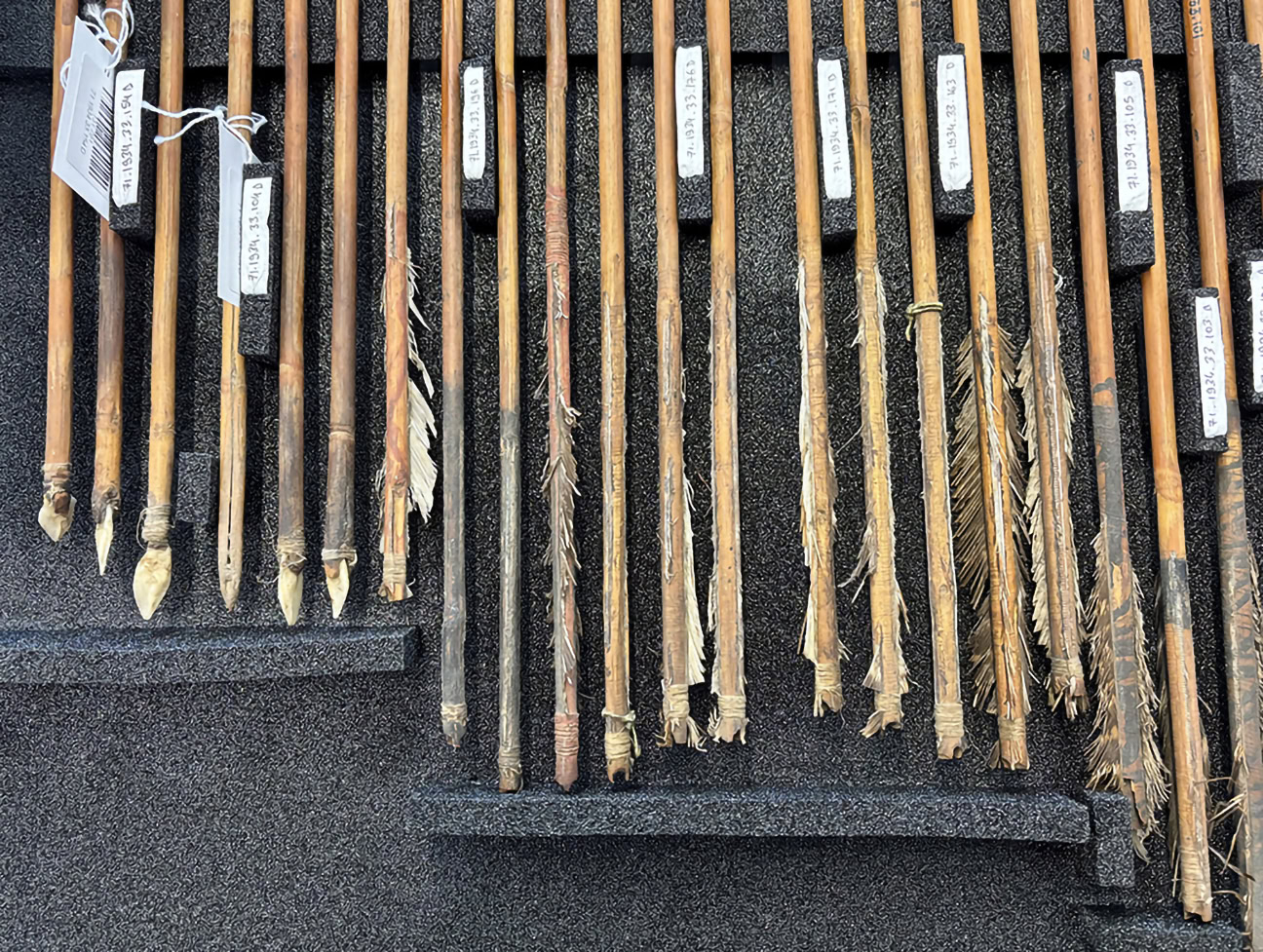
One of the most impressive parts of the collection, a part that has not yet come to Oklahoma, is the arrows. The Branly has 115 arrows from the Southeast and Central U.S. that date to the 1700s. Based on their construction, most of these arrows fit into groups that likely represent eight different arrow-makers from several different tribes, along with a handful of miscellaneous individual arrows. The arrows in this collection hold neat human details. On a few arrow shafts are bare teeth marks left when the maker straightened the arrow in his mouth 300 years ago. Other arrows were made by the same maker at different times and showed how he used different raw materials when they were on hand.
For Southeastern cultural revitalization work, the Branly arrows are extremely important because they date from about a century earlier than the earliest Southeastern arrows available for study in U.S. museums. Made long before the Trail of Tears, they give us a unique opportunity to learn about this part of Indigenous culture, directly from the workmanship of the grandfathers.
As someone who makes Choctaw bows and stone-tipped arrows and hunts deer with them every year, I was deeply honored to get to handle this collection. Many gems of traditional knowledge can be learned or confirmed from studying these pieces. Focusing on the arrows in the collection that could conceivably be Choctaw-made (about 88), some of what we see is expected.
Many of the shafts are made of river cane; some are split hardwood; only a few are hardwood shoots. Many of the cane arrows were tipped simply by sharpening and fire hardening the end of the cane. Others were tipped with garfish scales attached with sinew and hide glue. The way these were attached would have limited penetration, suggesting small game as the intended target.
A few other arrows are tipped with carved deer antler. Of the arrows that could possibly be Choctaw-affiliated, only one has a chipped stone point, and two have chipped glass points. Given the rarity of chipped arrow points at 1700s Choctaw archaeological sites, this was expected. The smooth transitions on these particular arrows suggest that they were intended for punching deep holes into big animals or enemies.
The entire collection of arrows includes only a few with metal tips. All of the arrows that are still complete enough to tell, have fletchings made from three split feathers, wrapped with sinew or plant fiber at both ends and glued to the shaft down the length of the quills. All of this was pretty much expected, based on what has been passed down to us.
Other characteristics of these arrows were unexpected, and this is where some of the best learning comes from. Most of the Choctaw arrows that we have in the U.S. to study date from the late 1800s or early 1900s. They are thick-shafted, heavy, and have big air-catching fletchings. Old, written accounts indicate that in previous generations, Choctaw bows had been even more powerful than they were in the late 1800s. I had expected the arrows in the Branly collection to be massively made to match those powerful early bows, but they are exactly the opposite.
Nearly every single arrow in the Branly collection is lightweight, one-third of what some later Choctaw arrows weigh. The shafts on the 1700s arrows are thin, and our ancestors must have had a means for overcoming the archer’s paradox. The surviving fletchings are cut short and parabolic, more like a modern store-bought arrow.
Since the advent of the bow, there have been two competing schools of thought on arrow design. One group advocates for heavy, relatively slow-moving arrows that hit with high momentum. The other group advocates for light arrows that fly far and hit with high velocity. The design of Choctaw archery equipment from the late 1800s falls squarely into the heavy camp. A century earlier, Choctaw archery design was on the light and fast side of things.
We wouldn’t even know about this change in arrow design if it weren’t for the Branly’s unique collection of arrows. How can we identify the reason for the change? Multiple early accounts from the Southeast talk about bows so powerful that European soldiers couldn’t pull them back.
Using these, Native men could fire arrows to engage individual targets out to 200 yards and penetrate deeply. Doing that took a tremendous amount of skill, both in making the archery equipment and shooting it. The same accounts describe highly competitive Native archery traditions in which males vied against each other in bow design and marksmanship from age 4 onward.
Later, when the gun came along, it made it possible to engage distant targets while investing only a fraction of the time and practice required to do that with a bow. The redesign of Choctaw arrows in the 1800s could be explained as Choctaw communities adapting to the gun by shifting archery to focus on closer-range targets and hitting them with more knockdown power.
We are out of space for now, but there is much more to share. In the coming months, the Choctaw Nation Historic Preservation Department will continue working to make the traditional knowledge in the Branly collection more accessible to the Choctaw community.
Additional Information
There have been several past articles of Iti Fabvssa that have touched on the Choctaw bow and arrow, including topics ranging from what they meant to the Choctaw people to how they were used and made.