
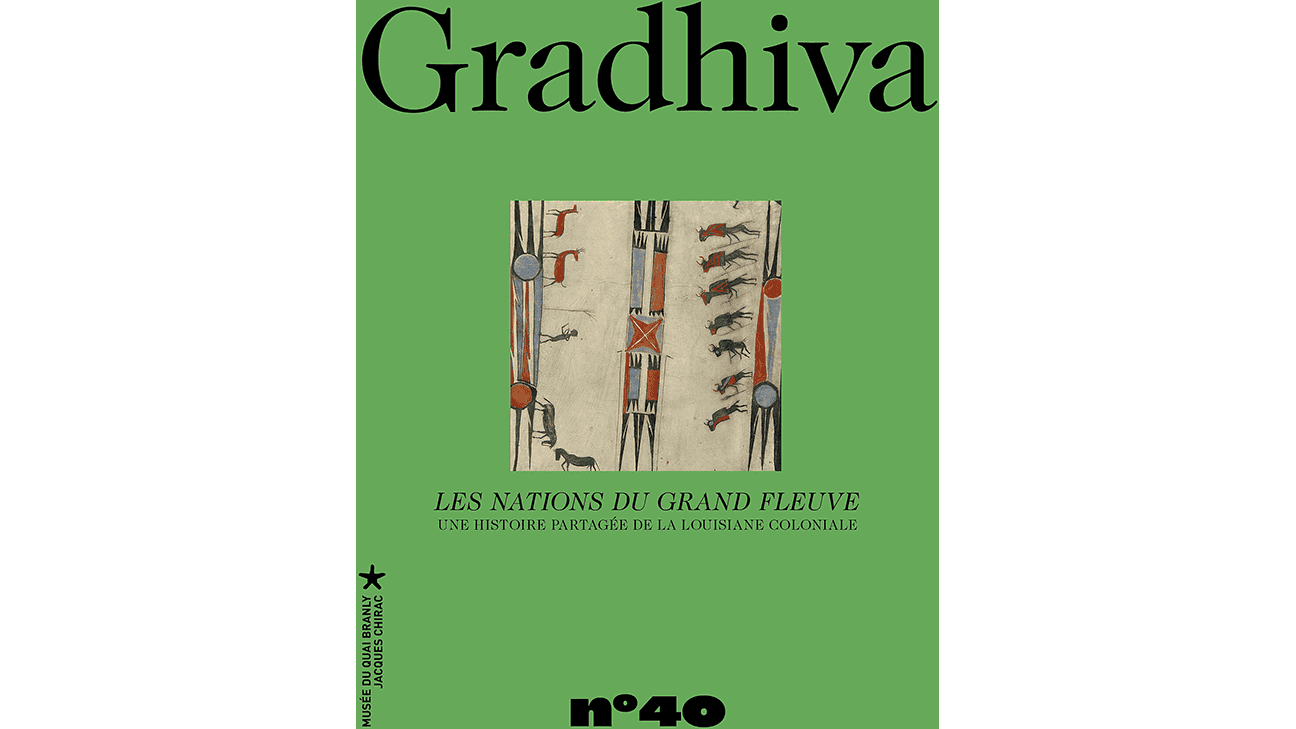
Gradhiva No. 40 is a French publication of the Musée du quai Branly–Jacques Chirac and features articles by Choctaw and other Indigenous authors.
Allies of the French: Continuing collaborations with the Musée du Quai Branly – Jacques Chirac
Iti FabvssaPublished February 1, 2026France and Choctaw Nation were allies through some of the most significant years of the colonial period. In 1724, the leaders of French-allied Tribes were invited to travel to France on a diplomatic mission to meet with King Louis XV. In November 1725, a delegation of Tribal leaders from what are today the Miami Tribe of Oklahoma, Otoe-Missouria Tribe of Oklahoma, Osage Nation, and Peoria Tribe of Indians of Oklahoma met with the king. In November 2025, 300 years after that meeting, leaders and representatives from historically French-allied Tribes returned to France to share stories, perspectives, and collaborative research about the historic alliance. This was not a one-off event, but a culmination of years of collaborative work involving a French National Museum (The Musée du quai Branly –Jacques Chirac) and the historic preservation departments of a number of Oklahoma Tribes, including the Choctaw Nation. These international relationships have been valuable for several reasons. One of them is learning more about 1700s Choctaw history and Choctaw culture in a way that can be of benefit to Choctaw Nation as we work to expand modern sovereignty and reawaken parts of traditional culture that are currently sleeping. In this article, we will share resources where readers can access some of the information about Choctaw history and culture that has come to light through this collaboration. We hope you find it interesting and useful!
In 2016, the Choctaw Nation’s Historic Preservation Dept. reached out to the Musee du Quai Branly Museum about objects in their collection that are or may be culturally affiliated with the Choctaw people. Relationship-building and information exchange led to an exhibit at the at the Versailles Public Library titled “An Inquisitive Prince”, which drew attention to important cultural objects in the Branly’s collection that may be affiliated with Choctaw people. This exhibit included information about the Choctaw Nation of Oklahoma to show French visitors that we’re still here (see the October 2021 Biskinik Iti Fabvssa article titled “Renewing Choctaw-French relations through an exhibit collaboration”, the online video “An Inquisitive Prince” Exhibit Virtual Opening, and the website Behind the Scenes of the Choctaw Video for the Exhibit “An Inquisitive Prince”). An expanded version of this exhibit titled “Okhvta Chito Okhoatali: Choctaw and French Transatlantic Legacies” was hosted by the Choctaw Cultural Center in 2024 so that community members could see these objects and hear some of the stories.
The Branly has what is probably the world’s foremost collection of 18th-century Native American cultural objects from the Southeast and central US. Some of these objects are almost certainly Choctaw, but many others are culturally affiliated with other Tribes. Through the CROYAN Project,the Branly made it possible for representatives from some of the historically French-allied Tribes (Miami, Peoria, Quapaw, and Choctaw Nation of Oklahoma) to look through its collections together. They made it possible for the Tribes to see other early Native American cultural objects curated by other French institutions like the National Library of France and the Versailles Public Library. They also made it possible for the Tribes to visit French archives and view early French maps of our home areas. These maps are important as they contain historical, linguistic, and cultural knowledge and provide examples of our ancestors’ lifeways and relationships with the landscapes of our homeland. These maps are stored at National Archives of France, Vincennes Historical Archive Center, and the National Library of France. Many of them can be accessed online through the Gallica digital library.
In discussing the maps and cultural objects with our colleagues from the other Tribes, and our colleagues from France, we found something amazing. Through our own histories, cultures, and languages, each had parts of a bigger story. When we brought these different knowledges and perspectives together in the same room, stories of Tribal history, Tribal traditional culture, and international alliances poured out and braided together into a holistic, vibrant picture in a way that none of the parties could have done on its own.
In November 2025, the Branly hosted the “Sharing Collections, Co-Writing History: New Collaborative Practices within Indigenous North American Contexts” symposium in Paris, France. The afore-mentioned Tribes, joined by others, and Branly staff gave joint presentations with each other about the collaborative research that has been done over the past years. Many of these collaborative research projects were also published for a wider audience (Gradhiva No. 40 “The Nations of the Great River: A Shared History of Colonial Louisiana”). Hopefully, this kind of work will become the norm in the future. It’s of value to institutions because it provides them with more knowledge about their collections. It’s of value to Tribal communities working to restore, revitalize, and reconnect.
After the symposium the Branly, in collaboration with the afore-mentioned Tribes, opened a joint exhibit at Versailles Palace, “1725. Native American Allies at the Court of Louis XV”. This exhibit will run until March 3rd, 2026 at the Palace of Versailes. It speaks to the relationships between France and Native Nations during the 18th century and the trip by delegation of Native Leaders to meet King Louis XV. Tribal representatives from each of the Tribal Nations got to participate in the opening of the exhibition and interact with the French public. Our hope for the next collaborative project is to bring the exhibit to Oklahoma, where our communities can see the cultural objects and read the stories for themselves.
To learn more about these partnerships, we encourage you to view this Iti Fabvssa article online as it contains many online links to additional web content. You can find the Iti Fabvssa online at ChoctawNation.com or on Choctaw Nation’s social media.